
WELCOME BONUS 300%
UP TO €2000 + 100
FREE SPINS
UP TO €2000 + 100
FREE SPINS
Home → Blackjack
Blackjack at Red Dice: Variants, Rules and Payouts
How much time is left for the decision?
Blackjack Surrender (Late Surrender) allows a player to forfeit half the bet after the dealer checks for blackjack, improving the RTP by approximately 0.08 percentage points compared to standard play without this option. This rule modifier requires quick action before hitting or standing, effectively reducing the house edge slightly in specific scenarios where surrendering yields a better mathematical outcome than continuing the hand with a weak total.
The early surrender variant offers a significantly higher benefit of up to minus 0.6 percentage points against the house, yet it remains extremely rare in modern online casino environments and is seldom found in digital implementations compared to the late surrender version available at most venues. Players must recognize that this superior rule does not exist on typical mobile platforms, limiting strategic flexibility during live sessions.
Standard Blackjack Ein Deck games operate under classical rules with a 3:2 payout, delivering an impressive RTP of 99.85% and a minimal house edge of only 0.15 percent. Fewer decks generally lower the casino advantage, as a single deck provides roughly minus 0.48 percentage points compared to eight-deck shoes, though operators often compensate by offering inferior 6:5 payouts that negate this statistical benefit entirely.
Double Down after Split: which tables allow it
Blackjack 6 Decks featuring S17, DAS, and DOA rules permit doubling down after splitting, contributing to a 0.14 percentage point reduction in the house edge when this liberal feature is active alongside other favorable conditions like soft 17 stands. The requirement for strict basis strategy implementation becomes mandatory to achieve the stated 99.54% RTP figure, ensuring optimal decision-making across all possible hand combinations generated during gameplay.
Resplitting Aces improves the return by approximately 0.08 percentage points, while Double After Split adds another 0.14 percentage points to the player's theoretical yield, creating a combined benefit that significantly enhances long-term profitability for disciplined participants who adhere strictly to established basic strategy charts.
In contrast, the absence of these liberal features increases the house advantage substantially, making tables without DAS or RSA options less attractive for serious players seeking maximum value from their bankroll management strategies over extended playing periods and multiple session durations.
How many decks are in the shoe?
Blackjack Ein Deck utilizes a single card shoe, resulting in a house edge of just 0.15% and an RTP of 99.85%, which represents one of the most favorable conditions available to players willing to seek out such specific table configurations and limited seating arrangements.
Switching to a six-deck shoe with S17, DAS, and DOA rules increases the house edge to 0.46% and lowers the RTP to 99.54%, demonstrating how additional decks systematically erode player advantages despite maintaining otherwise identical core gameplay mechanics and payout structures.
Using eight decks instead of six adds approximately 0.02 percentage points to the house edge, illustrating the cumulative impact of deck count on overall game volatility and expected returns for consistent participants tracking their performance metrics over thousands of hands played.
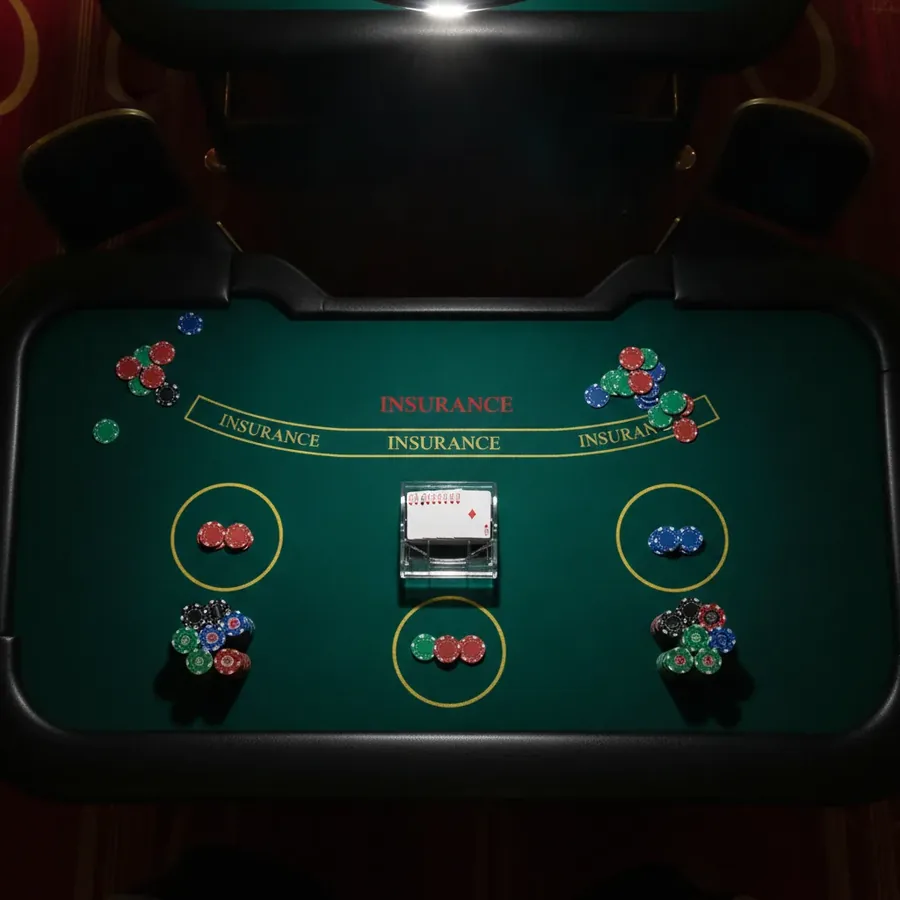
Insurance vs Even Money on Own Blackjack
Blackjack Insurance functions as a separate side bet covering up to 50% of the main wager when the dealer shows an ace, paying 2:1 but carrying a steep house edge of 7.47% and an RTP of merely 92.53% for six to eight deck games. Basic strategy dictates always rejecting this wager unless counting cards reveals a true count greater than or equal to plus three, indicating a favorable deck composition for this specific risky proposition.
Even money represents a guaranteed 1:1 payout on a natural blackjack when the dealer also holds an ace, mathematically equivalent to taking insurance on a twenty-one hand but eliminating variance entirely. This choice locks in immediate profit regardless of the dealer's hole card, though it sacrifices potential upside if the dealer does not complete their own blackjack hand.
For a single-deck game, the insurance house edge drops to approximately 5.88%, yet it remains statistically inferior to holding the natural twenty-one until resolution, proving that accepting even money never improves expected value compared to letting the original bet ride through completion.
Insurance Pays 2:1 Yet Still Costs Money
The Quantum Blackjack Plus Live table by Playtech features quantum multipliers reaching up to 1,000x on three-card twenty-one combinations, offering an RTP of 99.57% with optimal strategy, distinct from standard insurance wagers that consistently drain bankrolls over time due to negative expectation calculations.
Infinite Blackjack by Evolution provides unlimited seats and four side bets including Any Pair, 21+3, Hot 3, and Bust It, achieving an RTP of 99.47%, while traditional insurance bets attached to such tables remain highly unfavorable with edges exceeding seven percent regardless of dealer upcard visibility.
Blackjack Party by Evolution creates a party atmosphere with two moderators and betting limits ranging from 1.00 to 1,000 EUR, contrasting sharply with the cold mathematics of insurance bets that cost players money despite their attractive 2:1 payout ratios appearing deceptively generous to casual observers.
Blackjack variants at a glance
| Variant | Payout | House edge | Rule | Bet range |
|---|---|---|---|---|
| Blackjack Surrender (Late Surrender) – Regel-Effekt | n.a. (Regel-Modifikator) | −0.08 Prozentpunkte | Spieler gibt Hand nach Dealer-Blackjack-Prüfung auf, verliert die Hälfte des Einsatzes. Verbessert RTP um ca. 0.08 Prozentpunkte. Early Surrender ist wesentlich wertvoller (bis −0.6 Prozentpunkte), aber extrem selten. | Rückzahlung 50% des Einsatzes |
| Blackjack Liberal Vegas Strip (liberale Regeln, 3:2) | 99.72% | 0.28% | Günstigste Regelkombination: S17 + DAS + Resplit + Late Surrender. Standardabweichung 1,15 | Blackjack 3:2, Gewinn 1:1 |
| Blackjack Ein Deck, klassische Regeln, 3:2 | 99.85% | 0.15% | Weniger Decks = niedrigerer Vorteil; ein Deck gibt ca. −0.48 Prozentpunkte gegenüber 8 Decks. Oft durch 6:5 Auszahlung kompensiert. | Blackjack 3:2, Gewinn 1:1 |
| Blackjack 6 Decks, S17, DAS, DOA, Auszahlung 3:2, Basisstrategie | 99.54% | 0.46% | Dealer steht auf Soft 17; Verdopplung auf jeder Zweierkarte; Verdopplung nach Split erlaubt; keine Aufgabe. Basisstrategie ist für diesen Wert zwingend | Blackjack 3:2, normaler Gewinn 1:1, Insurance 2:1 |
| Blackjack Split / Double / H17 – Regel-Effekte | n.a. (Regel-Modifikatoren) | H17 +0.22 Prozentpunkte; RSA −0.08 Prozentpunkte; DAS −0.14 Prozentpunkte | Dealer Hits Soft 17 verschlechtert RTP um 0.22 Prozentpunkte; Resplit Aces verbessert um 0.08 Prozentpunkte; Double After Split verbessert um ca. 0.14 Prozentpunkte; 6 Decks statt 8 – ca. 0.02 Prozentpunkte. | Double – Einsatz ×2 mit einer Karte; Split – bis 4 Hände; Ass-Split meist mit einer Karte. |
| Blackjack Insurance / Versicherung (6–8 Decks) | 92.53% | 7.47% | Separate Nebenwette bis 50% der Hauptwette, wenn der Dealer ein Ass hat. Basisstrategie schreibt IMMER Ablehnung vor (außer Karten zählen bei True Count ≥ +3). Bei einem Deck Vorteil ≈ 5.88% | Insurance 2:1 |
Surrender vs Playing Out on 16 vs 10
Late Surrender improves the RTP by approximately 0.08 percentage points compared to standard play. This rule allows players to forfeit half their stake after the dealer checks for blackjack, effectively reducing the house edge. For a player using strict basic strategy, this small adjustment provides a measurable mathematical advantage over simply hitting or standing.
Standard surrender rules typically cost 50% of the original bet when exercised correctly against strong dealer upcards like ten values. Early surrender is significantly more valuable, offering a reduction of up to 0.6 percentage points in the house edge, but it remains extremely rare in online environments. Most platforms only offer the late variant, which limits the strategic depth available to disciplined bankroll managers.
Applying surrender correctly on hard 16 against a dealer ten saves money that would otherwise be lost through poor hit decisions. The payout structure ensures a return of 50% of the wagered amount rather than zero upon folding. This specific tactical choice becomes essential for minimizing variance during long sessions where dealer strength frequently peaks at ten-valued cards.
Four hours of play with 300 EUR bankroll
Blackjack contributes only 10% toward bonus turnover requirements, whereas slots contribute 100%. With a 300 EUR bankroll and a 300% welcome bonus up to 2,000 EUR, playing table games slows down the clearing process significantly. A player must generate much higher total turnover on tables to meet the same wagering targets as slot players.
The house edge for liberal Vegas Strip rules sits at just 0.28%, allowing funds to last longer than high-edge variants. Infinite Blackjack offers a 99.47% RTP, further preserving the initial deposit over extended periods. However, the low contribution rate means four hours of steady play might clear only a fraction of the required bonus conditions.
Mathematically, a 300 EUR stake combined with the maximum 2,000 EUR bonus creates a large theoretical turnover target. If the wagering requirement is 40x, the total turnover needed reaches 80,000 EUR. Since tables count at 10%, the actual betting volume required from the player increases tenfold compared to unrestricted game types.
Mobile users face similar constraints when switching between game categories during these four-hour sessions. The contribution percentages remain fixed regardless of device type, so strategic planning must account for the slower accumulation of bonus progress on mobile blackjack tables.
Infinite Blackjack uses the Six Card Charlie
Infinite Blackjack features side bets including Any Pair, 21+3, Hot 3, and Bust It alongside the main game. These optional wagers introduce distinct volatility profiles compared to the base game's 99.47% RTP. Players must understand that these additions increase the overall house edge beyond the standard 0.53% margin.
The six-card Charlie rule automatically wins if a player draws six cards without busting, adding an exciting exception to standard drawing logic. This rule often appears in infinite seating formats where multiple hands can develop independently. It serves as a strategic buffer for players holding weak starting totals who manage to draw carefully.
Bet limits range from 1 EUR to 5,000 EUR, accommodating both casual mobile players and high rollers. The unlimited seating capacity ensures no waiting times, which is crucial for maintaining flow during short mobile sessions. Each hand resolves independently, meaning the six-card win triggers immediately without waiting for other players' outcomes.
Double Down vs Simple Hit on 11
Doubling down on eleven against a dealer ten maximizes expected value compared to hitting or standing. Basic strategy dictates doubling whenever possible because the next card has a high probability of being a ten-value card. This aggressive move converts a likely loss into a potential double win if the dealer also holds a strong hand.
The insurance bet pays 2:1 but carries a house edge of 7.47%, making it a poor strategic choice for most players. While doubling down on eleven requires exactly double the initial wager, it aligns with optimal mathematical expectations. Accepting insurance instead of following this core principle erodes long-term profitability significantly.
Resplitting aces and doubling after split are favorable rules that slightly improve the overall RTP. These modifiers reduce the house edge by 0.08 and 0.14 percentage points respectively in liberal variants. Mobile players should verify these specific rule sets before committing to a table, as they directly impact the efficiency of doubling strategies.
Hit soft seventeen rules add 0.22 percentage points to the house edge, penalizing players who do not adjust their doubling tactics accordingly. Understanding how dealer rules influence the decision to double on eleven helps optimize bankroll management. This knowledge is particularly vital when navigating the varied rule configurations found across different live casino providers.
When can you increase your bet?
Quantum Blackjack Plus Live introduces multipliers up to 1,000x on three-card combinations totaling 21 points. These random quantum events allow for sudden, massive payouts without changing the underlying bet size. Players experience heightened volatility as these multipliers trigger unpredictably during the round.
Side bets such as Hot 3 or Bust It in Infinite Blackjack offer alternative ways to profit from specific card patterns. These wagers operate independently of the main hand result, providing additional opportunities for increased returns. The RTP for Quantum Blackjack stands at 99.57% when optimal strategy is applied to the main game.
Live tables like Evolution's Blackjack Party feature two moderators creating a party atmosphere with varying engagement levels. Bet ranges from 1.00 EUR to 1,000 EUR allow flexible staking strategies during these themed sessions. Increasing bets strategically during multiplier events or favorable shoe compositions can capitalize on temporary variance shifts.
Error insurance: 7 percent additional house edge
Insurance is a separate side bet paying 2:1 when the dealer shows an Ace. This wager carries a house edge of 7.47% in multi-deck games, drastically reducing the overall RTP to 92.53%. Accepting this offer converts a statistically neutral moment into a significant long-term loss for the player.
The basic strategy dictates always rejecting insurance unless counting cards reveals a true count of at least +3. Even with perfect card counting skills on a mobile device, isolating this specific count remains exceptionally difficult during live play. The mathematical disadvantage outweighs any potential short-term gain from the 2:1 payout structure.
This rule applies universally across standard blackjack variants available on the platform. Players who frequently accept insurance will see their bankroll erode much faster than those adhering to optimal strategy. Avoiding this side bet preserves the base game's theoretical return rate.
Card Counting at Shuffle Master Table: why it fails
Quantum Blackjack Plus Live by Playtech utilizes continuous shuffling mechanisms that prevent effective card tracking. Each hand is drawn from a freshly shuffled shoe or automatic shuffler, negating the advantage gained from previous rounds. Mobile players cannot maintain a running count when the deck composition resets constantly.
Even Infinite Blackjack by Evolution, which offers unlimited seats, often employs frequent reshuffling protocols during high traffic. While the RTP stands at 99.47%, the inability to track card depletion removes the core mechanic of card counting. The live dealer environment prioritizes game flow over statistical variance exploitation.
Mobile interfaces further complicate manual tracking due to smaller screen real estate and intermittent connectivity. Players attempting to use complex counting systems face operational friction that degrades decision-making speed. The software design inherently favors casual play over strategic advantage betting.
Which rule variants does the software show?
Blackjack Auszahlung 6:5 statt 3:2 appears in six-deck games, altering the fundamental payout structure significantly. A natural blackjack pays $12 instead of $15 on a $10 bet, adding exactly 1.39 percentage points to the house edge. This single rule change makes the game substantially less favorable compared to standard 3:2 tables.
Standard rules like S17, DAS, and DOA are often paired with the punitive 6:5 payout in these variants. The combination results in a house edge of 1.85% despite other player-friendly conditions being present. Players must verify the payout ratio before sitting down, as it overrides other beneficial rules.
In contrast, Liberal Vegas Strip rules offer a much better RTP of 99.72% with a 0.28% house edge. These tables strictly adhere to the 3:2 payout and include late surrender options. Identifying these specific rule sets on mobile requires checking the game details prior to placing the first chip.
No Double Down on three cards
Resplit Aces (RSA) improves the RTP by approximately 0.08 percentage points, but restrictions apply to doubling down. Most mobile tables limit doubling to only two cards after a split, removing a key strategic option. This limitation reduces the player's ability to capitalize on favorable hands following a split action.
Double After Split (DAS) is explicitly excluded in many 6:5 variant configurations found on the platform. Without DAS, players lose the opportunity to double their stake on weak initial splits like 8-8 against a dealer 5. The absence of this rule increases the house advantage beyond the stated baseline.
Players relying on aggressive doubling strategies must adjust their approach to fit the two-card restriction. This constraint forces more conservative play, potentially leaving money on the table in winning scenarios. Understanding these limitations is crucial for managing expectations on mobile devices where quick decisions are paramount.
Check table limit before the first bet
Blackjack Party by Evolution accepts bets ranging from 1.00 EUR to 1.000 EUR per hand. High rollers can test strategies with larger stakes within this defined bracket without hitting minimum constraints. The lower bound allows for low-risk testing of new rule variations on mobile screens.
Quantum Blackjack Plus Live extends the upper limit to 5.000 EUR, catering to high-stakes mobile players. Multipliers up to 1,000x apply to three-card combos, creating volatile outcomes within the permitted betting range. Players must ensure their bankroll supports the maximum potential exposure at this tier.
Infinite Blackjack also caps bets at 5.000 EUR while offering four distinct side bets like Any Pair. These side bets operate independently of the main hand limits but contribute to overall volatility. Verifying the specific table limits prevents accidental rejections of bets placed via the mobile interface.
Contact
Live - online chat
Banking









Providers












Red Dice Casino 2026